How to Choose AI Autoblogging Tools for Research Driven Writing: A Buyer's Guide
Buying an AI autoblogging tool for research driven writing is a decision you make once and live with for years. Most buyers compare feature lists and miss the part that matters: whether the tool actually reads the SERP, pulls LSI keywords, and extracts knowledge graph entities before it writes a word. Get that wrong and you pay for drafts you rewrite anyway.
This guide shows you how Autoblogging.ai handles Godlike Mode, Quick Mode, News Mode and Bulk Generation, what its credits and rollover mean for research heavy workflows, and which buyers the platform genuinely fits. By the end you will know whether to buy it or keep looking.
What Is Autoblogging.ai and How Does It Serve Research Driven Writing?
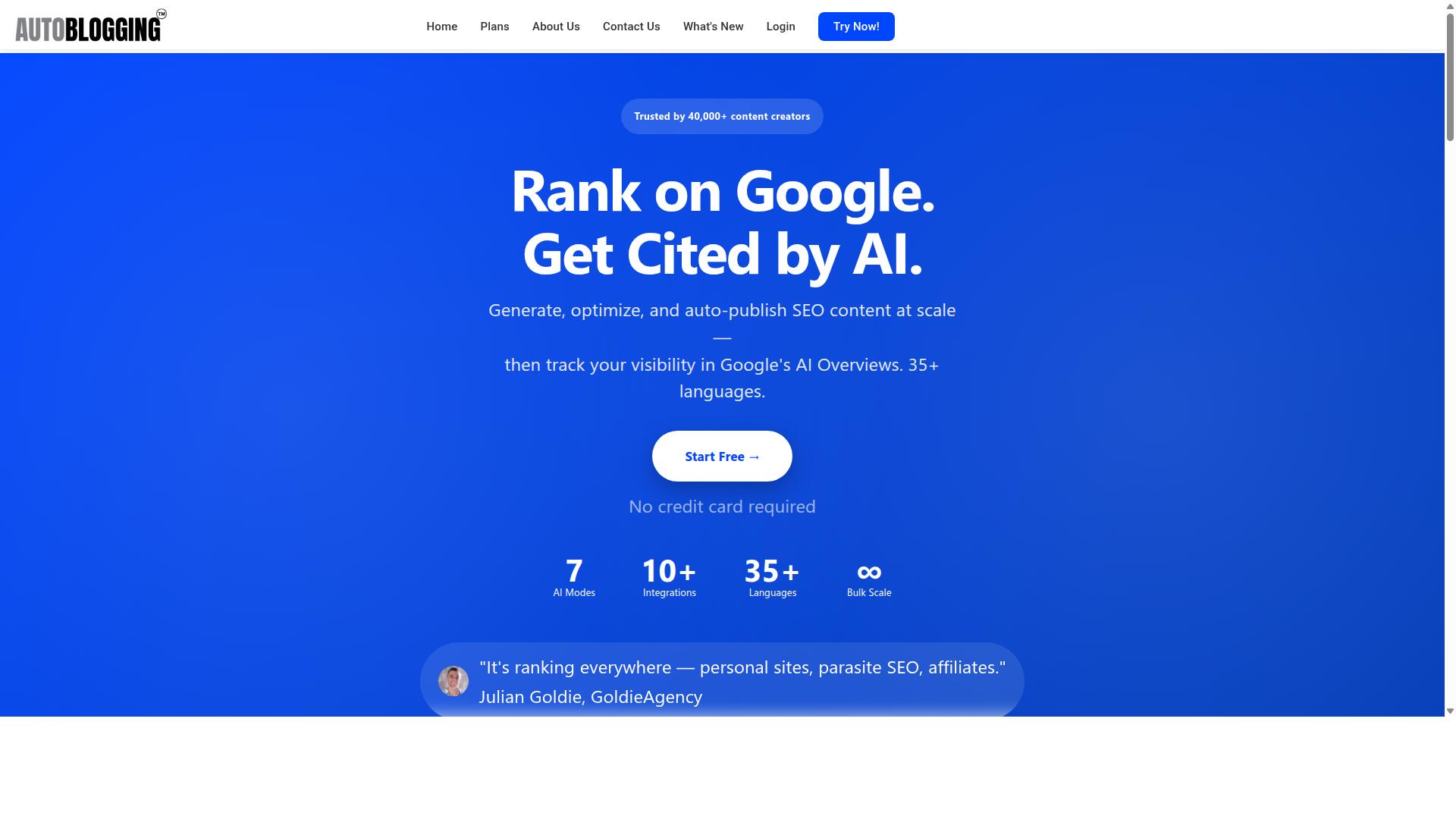
Autoblogging.ai is an AI-powered content generation platform that automates the research and writing process for bloggers, SEO professionals, and agencies. It is a SaaS tool built by Digimetriq.com and founded in 2022, with a clear mission: help website owners and agencies save time and improve their online presence through cutting-edge technology.
At its core, the platform uses AI to generate articles. But the emphasis is not on volume alone. The system is designed around research-driven writing, meaning the output is shaped by data gathered before a single sentence is drafted.
That research layer is what separates it from a basic text generator. Autoblogging.ai analyzes SERPs, extracts LSI keywords, and builds knowledge graphs to inform the writing. These three steps give the AI a factual and semantic foundation rather than asking it to guess at a topic.
For anyone weighing AI autoblogging tools in a buyer's guide, this distinction matters. A tool that studies the search landscape first is better positioned to produce content that fits real search intent and supports topical authority.
In practice, Autoblogging.ai serves research-driven writing by automating three stages that normally consume the most human hours:
- Data gathering: analyzing SERPs and pulling out LSI keywords tied to the topic.
- Outline creation: structuring a draft around the entities and relationships found in the knowledge graph.
- Draft generation: producing the initial article while keeping factual accuracy and SEO optimization in view.
The platform also supports 35+ languages and offers multiple AI modes, so users can match the output style to different projects and audiences. That flexibility matters for agencies running campaigns across regions or niches.
Digimetriq's stated aim is to cut down content costs and give the power to human counterparts in SOPs with the first draft. Autoblogging.ai fits that goal neatly: it handles the heavy research and drafting work, while the human editor reviews, refines, and publishes.
For a buyer comparing options, the takeaway is straightforward. Autoblogging.ai is a legitimate, purpose-built platform for research-driven content automation, not a generic spinner. It combines semantic SEO signals, knowledge graph construction, and multilingual generation in one workflow, which makes it a strong candidate for bloggers and agencies who want efficiency without abandoning quality control.
Why Autoblogging.ai Is Built for Research Driven Content Buyers
Content buyers seeking research-backed articles need tools that go beyond basic text generation and incorporate competitor analysis, semantic SEO, and factual grounding. Research-driven writing demands accuracy, depth, and measurable SEO performance, three requirements that generic AI writers often struggle to meet.
Autoblogging.ai was designed around those exact priorities. Its platform automates the complex research tasks that normally slow writers down, from SERP analysis to entity extraction, so content buyers can focus on strategy instead of manual investigation.
This section breaks down the specific modes and features that serve research-heavy workflows. The subsections below cover Godlike Mode's competitor and knowledge graph capabilities, plus the specialized modes that handle different content types and volumes.
Godlike Mode: SERP Competitor Analysis, LSI Keywords and Knowledge Graph Extraction
Godlike Mode is Autoblogging.ai's most advanced content generation setting, designed to produce deeply researched articles by analyzing top-ranking competitors and extracting semantic entities. It performs SERP competitor analysis to identify who currently ranks for a target keyword, then mines those sources for the semantic signals that search engines reward.
Two capabilities stand out here. First, LSI keyword extraction surfaces the related terms and phrases that top competitors use, giving writers a clearer picture of what comprehensive coverage looks like. Second, knowledge graph extraction builds a structured map of entities connected to the topic, which supports the kind of topical authority that competitive niches demand.
Entity extraction matters because modern search engines evaluate content by how well it covers a topic's related concepts, not just its primary keyword. A page that mentions the right entities in the right context signals genuine expertise. This is where semantic SEO and research-driven writing intersect.
A typical workflow looks like this:
- Enter your target keyword into Godlike Mode.
- Review the generated outline, which reflects gaps and patterns found across competing pages.
- Generate the full article based on that researched structure.
This mode suits long-form content and competitive niches where surface-level articles rarely rank. It supports 35+ languages, and it connects to WordPress integration for one-click publishing, so the finished piece moves straight to your site.
Quick Mode, Bulk Generation, News Mode and Amazon Reviews Mode Explained
Beyond Godlike Mode, Autoblogging.ai offers specialized modes to handle different content types and volumes, from rapid single articles to bulk generation of up to 500 pieces. Each mode draws on the platform's core research capabilities, so even fast output benefits from the same underlying analysis.
Quick Mode is free and built for single articles, with a wizard-guided creation flow. It works well for testing the platform, drafting a one-off piece, or checking output quality before committing to a larger workflow.
Bulk Generation handles scale. Users can create up to 500 articles at once through a CSV upload, which makes it a practical fit for agencies and publishers managing large content calendars.
News Mode integrates with Google News to produce timely news summaries. Content buyers who need fresh coverage of developing stories can use it to keep publishing schedules active without manual monitoring.
Amazon Reviews Mode generates product reviews based on Amazon data. This mode targets affiliate marketers who need review content tied to real product listings.
Here is how the modes map to common use cases:
- Quick Mode: testing, single articles, wizard-guided drafts
- Bulk Generation: scaling content across hundreds of pieces
- News Mode: timely updates and news summaries
- Amazon Reviews Mode: affiliate product reviews
All modes can be customized with tone and style settings, letting buyers align output with brand voice across every content type. That combination of research depth and flexibility is what separates a tool built for research-driven buyers from one that simply generates text.
Key Features and What Makes Autoblogging.ai Stand Out
Autoblogging.ai distinguishes itself through a suite of features that streamline the entire content creation workflow, from research to publishing. While many AI autoblogging tools stop at generating a draft, this platform goes further by helping you plan, optimize, and distribute content across multiple channels.
The standout capabilities fall into three areas: site-level optimization, direct publishing, and a broad integration ecosystem. Each one addresses a different stage of the content lifecycle, which matters for anyone building topical authority over time.
Rather than listing every tool in the platform, the subsection below focuses on the features that have the biggest practical impact on research-driven writing and content automation.
Site Optimizer, One-Click WordPress Publishing and 35+ Integrations
Autoblogging.ai includes a Site Optimizer that analyzes existing content for SEO improvements, and it enables one-click publishing to WordPress and 35+ other platforms. These two capabilities, combined with a wide integration layer, turn a single article generator into a fuller content automation system.
The Site Optimizer scans a website, identifies content gaps, and suggests optimizations. For teams concerned with topical authority and semantic SEO, this shifts the tool from pure article production toward ongoing site improvement. Instead of guessing which subjects to cover next, you get direction based on what already exists on your domain.
Publishing is equally direct. The WordPress integration supports unlimited sites, a plugin, one-click publishing, and scheduled auto-posting, so articles move from draft to live without manual reformatting. Beyond WordPress, the platform supports Web 2.0 destinations such as Medium, Dev.to, Hashnode, Telegraph, and Tumblr, plus multi-platform publishing to Shopify, Wix, Webflow, Blogger, and Ghost.
Integrations extend that reach further:
- Zapier and n8n for connecting the platform to other apps in your stack
- API access for custom workflows and bespoke pipelines
- Web 2.0 and multi-platform publishing for broader distribution
- A Content Repurposer for adapting existing material to new formats
For research-driven writing, the value is consistency. A single workflow can take a topic from generation through optimization and out to several channels, which reduces the manual handoffs where quality and brand voice tend to slip. API access also means teams with existing systems can fold content generation into processes they already run, rather than maintaining a separate toolchain.
Taken together, these features save time and keep output aligned across channels, which is the practical case for choosing Autoblogging.ai in a crowded market of AI autoblogging tools.
Pricing and Plans: Credits, Rollover and Value for Research Heavy Workflows
Autoblogging.ai offers tiered monthly and annual plans based on credits, with all plans including credit rollover to accommodate fluctuating content demands. That structure matters for research-driven writing, where output rarely follows a neat monthly rhythm. A week of deep fact-checking and source attribution may produce fewer articles than a week of lighter updates.
Each plan is measured in credits, and credits are consumed per article generation. Heavier modes cost more credits because they involve deeper research, so buyers should map expected output against the credit allowance rather than the headline price alone.
| Plan | Monthly Price | Credits |
|---|---|---|
| Starter | $19 | 40 |
| Regular | $49 | 120 |
| Standard | $99 | 300 |
| Gold | $179 | 600 |
| Premium | $249 | 1,000 |
| Enterprise | $999 | 5,000 |
Credit rollover is the feature that separates flexible plans from rigid ones. Unused credits carry over to the next month, so a slow publishing cycle does not waste what you paid for. For teams juggling content briefs and outline generation alongside long-form production, that buffer smooths out uneven workloads.
Annual billing lowers the effective monthly rate across every tier. Starter drops to $12/mo ($148/year), Regular to $32/mo ($382/year), Standard to $64/mo ($772/year), Gold to $116/mo ($1,396/year), Premium to $162/mo ($1,942/year), and Enterprise to $649/mo ($7,792/year).
New accounts also receive 10 free credits per month, with no credit card required, which lets buyers test research-heavy generation before committing. Additional credits can be purchased when a project spikes beyond the plan allowance.
For agencies and bulk creators, the value curve favors higher tiers. Premium and Enterprise supply enough credits to sustain continuous output, and the per-credit cost falls as the allowance grows. A single-client blog may sit comfortably on Starter or Regular, while a multi-site operation running semantic SEO campaigns across several niches will find Standard or Gold more practical.
Done For You packages exist for buyers who want output without managing credits: Starter at $1,200 for 1,000 articles, Pro at $1,600 for 1,000 articles, Corp at $4,000 for 1,000 articles, and Senpai at $10,000 for 1,000 articles. These suit teams that prefer a fixed deliverable over a self-serve workflow.
Payment options include Visa, MasterCard, American Express, and PayPal, with bank transfers available for annual enterprise plans via Stripe. Cancellation is available at any time, so a plan can scale up for a heavy research quarter and scale back afterward without long-term lock-in.
The practical takeaway: estimate how many articles you need, weight that estimate for research-intensive modes, then choose the lowest tier whose credits cover it. Rollover protects the downside, annual billing reduces the cost, and higher tiers reward volume. For research-heavy workflows, that combination makes the pricing predictable rather than restrictive.
Trust Signals: 40,000+ Creators, 1M+ Articles and Verified Testimonials
Autoblogging.ai has generated over 1 million articles and is trusted by more than 40,000 content creators, as evidenced by a 4.9 average rating and endorsements from industry leaders. For anyone building a research-driven writing workflow, those numbers answer the question every buyer asks first: does this tool hold up in real use?
Trust signals matter in this category because AI autoblogging tools sit close to your brand, your publishing schedule, and your SEO results. A tool with a thin track record is a risk. A tool with thousands of active users and a documented output history is a much easier decision.
What makes the Autoblogging.ai signals credible is the mix. Volume alone can be gamed. Volume plus a high satisfaction score plus named, verifiable users is harder to fake.
- 40,000+ content creators rely on the platform
- 1M+ articles generated across those accounts
- 4.9 average rating from that user base
- New features shipped weekly, so the product keeps pace with changes in search and AI
- 24/7 support for users who publish around the clock
Each of these reduces a different kind of buyer risk: adoption risk, performance risk, satisfaction risk, stagnation risk, and support risk.
Verified testimonials add a layer that anonymous reviews cannot. The following professionals have attached their names, brands, and reputations to Autoblogging.ai:
| Name | Role / Brand |
|---|---|
| Julian Goldie | GoldieAgency, 250k+ YouTube subscribers |
| James Dooley | FatRank, PromoSEO |
| Bart Magera | MojoLinks |
| Kyle Duncan | SEO Professional |
| Dimitar Georgiev | CEO, IDEAMAX.EU |
These are people whose livelihoods depend on content performance. Julian Goldie and James Dooley operate in highly visible SEO and content circles, where a weak recommendation carries real reputational cost. Bart Magera, Kyle Duncan, and Dimitar Georgiev bring the same accountability from their own agencies and companies.
For a buyer, that matters more than a star rating. Named endorsements transfer risk away from you, because the person vouching has something to lose if the tool underdelivers.
Put together, the metrics and testimonials form a clear picture. Autoblogging.ai is not an untested experiment. It is a platform with a large user base, a long output record, a strong satisfaction score, and public backing from recognized practitioners.
That combination is exactly what a careful buyer should look for in any AI autoblogging tool: evidence of scale, evidence of quality, and evidence of accountability. Autoblogging.ai delivers all three, which is why it stands as a reliable choice for research-driven writing at scale.
Who Should Use Autoblogging.ai
Autoblogging.ai is designed for bloggers, website owners, SEO professionals, marketing agencies, content creators, and affiliate marketers who need to produce research-driven content at scale. These groups share one challenge: publishing enough quality material to stay competitive without burning out. The platform is available globally online, so location is not a barrier for any of them.
Here is how each audience typically benefits from content automation built around research-driven writing.
- Bloggers (personal and professional) save hours on outline generation, drafting, and editing, leaving more time for ideas and audience engagement.
- Website owners keep personal sites, portfolio sites, and local sites active with fresh posts instead of letting them go stale.
- SEO professionals build topical authority by covering clusters of related topics consistently, which supports semantic SEO and knowledge graph signals.
- Marketing agencies scale client websites more efficiently, producing content briefs and long-form content across multiple accounts.
- Content creators turn one idea into several formats while keeping tone of voice and brand voice consistent.
- Affiliate marketers produce product reviews and buying guides for affiliate sites, including parasite SEO placements, at a pace manual writing rarely matches.
Use cases matter as much as audience. A solo blogger on a personal site needs speed and readability scores. An agency managing client websites needs repeatable workflows and style transfer across brands. An affiliate marketer needs review content that holds up to fact-checking and plagiarism detection checks.
What ties these groups together is the demand for originality and source attribution. Research-driven writing means content grounded in real sources, not spun text. Buyers evaluating AI autoblogging tools should ask whether the platform supports citation management, fact-checking habits, and natural language processing quality from models like GPT-4, Claude, and Gemini.
If you fall into any of these categories and publish regularly, Autoblogging.ai is built with your workflow in mind. It serves bloggers, agencies, SEO teams, creators, and affiliate marketers alike, wherever they operate.
Final Verdict: Is Autoblogging.ai the Right Choice for Research Driven Writing?
Autoblogging.ai stands out as a robust solution for research-driven writing, combining advanced AI modes, extensive integrations, and a credit-based pricing model that scales with user needs. For buyers working through this guide, the decision often comes down to one question: does the tool match the depth of research your content requires? Based on its publicly listed features, Autoblogging.ai answers that question well.
Godlike Mode anchors the research-driven workflow, giving writers a way to produce deeper, more thoroughly developed articles rather than thin surface-level posts. Bulk generation then handles scale, so agencies and high-volume publishers are not forced to choose between depth and output. Together, these two modes cover the range most content teams actually need.
The platform also connects with 35+ integrations, which matters for teams that want content automation to fit into an existing publishing pipeline instead of replacing it. Credit rollover adds another layer of practical value, letting unused credits carry forward so seasonal or uneven publishing schedules do not punish buyers. For anyone weighing AI autoblogging tools, that flexibility is a genuine differentiator.
Trust signals round out the case. A published address in India and a United Kingdom office, along with direct phone, email, and Skype contact channels, suggest an established operation rather than an anonymous tool. Buyers comparing research-driven writing platforms should treat that transparency as part of the evaluation, not an afterthought.
No tool is without tradeoffs, and Autoblogging.ai is no exception. The pros are clear: meaningful time savings on research-heavy articles, built-in SEO optimization for search visibility, and global reach through multilingual content generation. For bloggers and SEO professionals, those three benefits alone often justify the switch.
The cons are worth naming honestly. Advanced modes such as Godlike Mode carry a learning curve, so new users should expect a short adjustment period before they get the most out of the platform. Heavy research usage also consumes credits faster, which means high-volume researchers need to plan their credit budget carefully rather than assume a single plan covers everything.
Neither drawback is unusual for a tool of this scope. What matters is whether the tradeoff suits your workflow. If your priority is speed at the expense of depth, a simpler generator may suffice. If your priority is research-backed, SEO-optimized content at scale, the balance tips firmly toward Autoblogging.ai.
So who is this platform genuinely built for? Three groups stand out:
- Bloggers who need consistent, well-researched posts without hiring a full editorial team
- Agencies managing multiple client sites and requiring bulk output with reliable quality
- SEO professionals focused on topical authority, semantic SEO, and long-form content that ranks
For these users, the combination of deep research modes, scale, integrations, and credit rollover creates a workflow that is hard to replicate with disconnected tools. The platform is less suited to writers who only need occasional short-form content, since the advanced capabilities would go largely unused.
If you are still deciding, the sensible next step is to test the platform against your own content briefs. A free trial lets you evaluate output quality, credit consumption, and ease of use before committing budget. For teams with specific requirements, contacting the company directly for a demo is a faster path to answers.
Contact details:
- India: 501, Trinity Orion, Vesu, Surat - 395007, Gujarat, India
- Phone/WhatsApp: +91 84605-06553 / +91-8460506553
- Email: [email protected]
- Skype: vibes.yb
- Hours: 7:00-19:00 IST
- United Kingdom: 2nd Flr, SEO Content Suite, 35 Water Ln, Wilmslow, Cheshire SK9 5AR
- UK Phone: +44 1625 359056
The verdict is straightforward. For research-driven writing at scale, Autoblogging.ai is a strong and defensible choice, backed by advanced modes, broad integrations, credit flexibility, and verifiable business contacts. Bloggers, agencies, and SEO professionals who prioritize research-backed content will find it fits their needs far better than generic alternatives.
Frequently Asked Questions
What should I look for in an AI autoblogging tool if my content needs to be research-driven?
Research-driven content depends on how well a tool can analyse what already ranks and turn that into useful material. Look for features like SERP competitor analysis, LSI keyword extraction and knowledge graph data rather than simple prompt-to-text generation. Autoblogging.ai's Godlike Mode is built around exactly this kind of SERP and keyword research, which makes it a good benchmark when comparing options.
How is Autoblogging.ai different from basic AI writers?
Basic AI writers typically generate an article from a single prompt with little input on the competitive landscape. Autoblogging.ai offers 10+ AI modes, including Godlike Mode with SERP competitor analysis, LSI keywords and knowledge graph extraction, plus Bulk Generation for up to 500 articles via CSV. It has generated over 1M articles and is trusted by 40,000+ content creators, so it is designed for volume and research depth rather than one-off drafts.
Do I need to worry about credit limits when choosing a plan?
Yes, because research-heavy modes usually consume more credits than quick drafts, so match the plan to your realistic monthly output. Autoblogging.ai's monthly plans range from Starter at $19 (40 credits) up to Enterprise at $999 (5,000 credits), with annual plans also available. Credits roll over, which helps if your publishing schedule fluctuates.
Can an AI autoblogging tool handle multiple sites, languages or client work?
If you run several sites or manage client projects, check language coverage, integrations and bulk workflows before buying. Autoblogging.ai supports 35+ languages and 35+ integrations, and its target users include bloggers, SEO professionals, marketing agencies and affiliate marketers working across personal, client and portfolio sites. Bulk Generation via CSV is particularly useful for agencies producing content at scale.
Is there human oversight, or is everything fully automated?
Even the best research-driven tools benefit from a human review pass before publishing. Autoblogging.ai includes a human proofreader in its offering, which adds a quality check on top of the AI output. Treat the tool as a way to remove the heavy lifting of research and drafting, not as a replacement for editorial judgement.
How do I know a tool is actively maintained and supported?
AI search and content landscapes change quickly, so ongoing development and responsive support matter as much as the feature list. Autoblogging.ai ships new features weekly and offers 24/7 support, with a 4.9 average rating from users. Checking review recency and release cadence is a smart step for any tool you shortlist.
Recommended Resources: